THE TRANSITION FROM EMPLOYEE WELL-BEING TO HEALTHY ORGANIZATION.
In recent years, the concept of employee well-being has gained significant attention in the corporate world. Companies have come to realize that the physical, emotional, and mental health of their employees is vital for the success of their business. However, as we move forward, the focus has shifted from individual employee well-being to creating healthy organizations. It is the responsibility of HR professionals to facilitate this transition.
The term "healthy organization" refers to an environment where employees feel valued, respected, and supported. It is an organization that recognizes the importance of its employees' well-being and takes proactive steps to promote it. The concept goes beyond traditional wellness programs and benefits, such as gym memberships and healthy snacks. It encompasses a range of practices that promote the overall health and wellness of employees (Rizvi, 2023).
The emergence of healthy organizations
The interesting article written by Budiraja, (2022) explain that a healthy organization is built on a people-centrist approach to all aspects of work. It entails shifting the emphasis away from traditional employee benefits and directing it towards a demonstrated commitment to psychological safety and fairness, as well as a culture of employee listening. Healthy organizations tend to cultivate a culture, climate, and practices that promote employee health and safety as well as organizational effectiveness. It becomes imperative for the organization to understand the importance of elevating the environment and culture that promotes and encourages their employees to hold their physical health, social health, as well as mental health on priority.
The need for Healthy organizations has emerged as a result of these newfound employee expectations. A work culture that values flexibility and puts employee well-being first. To develop a thriving organization and drive long-term growth, there is a need for workplaces that recognizes the significance of putting employees first. With an educational nudge from programs and solutions that help firms move well beyond well-being, these new difficulties can be transformed into possibilities. An aid in providing staff with the appropriate training, allowing the company to embrace productivity, growth, and resilience.
Video 1: Healthy and well being organization (Litmos heros, 2015)
Healthy Organization Framework

Evolution Of Well-being To The Healthy Organization
According to the Bersin (2023) expalin that, We have had hundreds of hours of meetings with CHROs and other HR leaders and they all say the same thing. We need programs and solutions that help everyone in the company be healthy, and they have to go far beyond well being. They want leaders to give people more flexibility. They want employees to feel empowered and well trained. And they want the organization as a whole to embrace productivity, growth, and long-term sustainability.
We call this evolution the shift from Well being as a benefit to a focus on The Healthy Organization. And our research shows how this works.
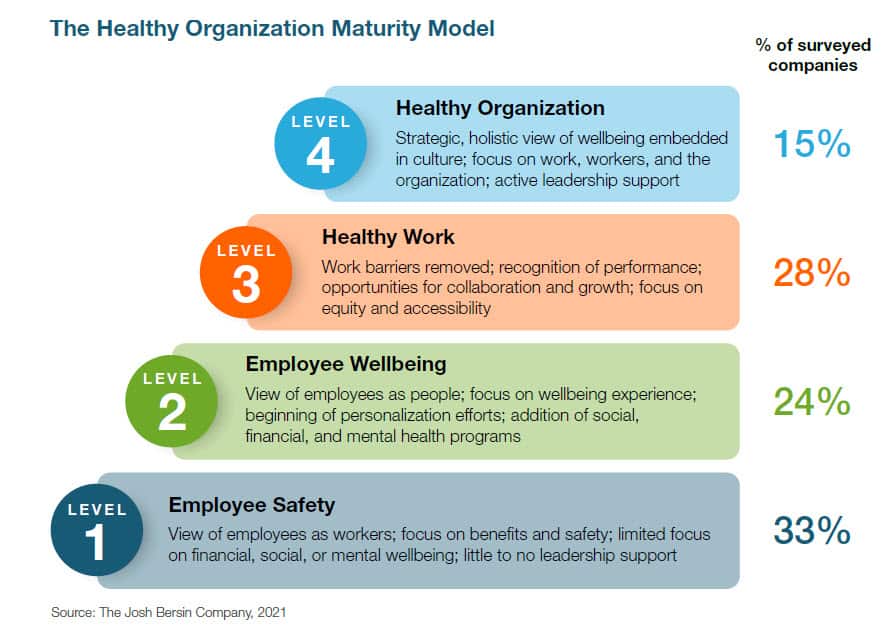 |
Figure 2 :Healthy organization maturity model (Bersin, (2023)
Level 1: Employee Safety
At the bottom level of maturity, companies focus on safety, a program that’s highly strategic in many industries. When I worked in the oil industry, we had to wear Nomex coveralls, hard-hat, and goggles in the refinery. It was a mandatory part of our work. Companies like Dow Chemical, Chevron, Cemex, and many others rank safety as their top priority. And this makes sense.
As Maslow’s hierarchy points out, when people don’t feel safe, nothing else can really happen. So at its core, a Healthy Organization is safe. Today safety has many meanings: physical safety is paramount, but so is psychological safety, safety to be yourself, and safety to take a break, rest, or slow down.
In the pandemic we all needed masks, vaccines, testing, and a safe workplace. But we also need psychological safety to speak up and ask questions, social safety to be quiet or show up late, and leadership safety to feel included, respected, and heard. All these matters, and as you can see, roughly a third of companies heavily focus in this area.
Level 2: Employee Wellbeing
At the next level of investment, companies built Wellbeing programs. And this is where most companies are. Every CHRO and CEO now has a Wellbeing strategy, and in many organizations (JP Morgan Chase, Workday) there are Wellbeing ambassadors, business partners, and specialists around the world.
The Wellbeing “program” is often run out of the benefits department, and it includes dozens or hundreds of programs, benefits, and healthcare offerings. Vendors like Gympass offer a wide range of fitness, mental health, and resilience programs (costing up to $500 per month per employee), and tools like Mequilibrium or Limeade offer resilience check-ins, education, and online assessments. Today nearly every large company has a whole constellation of these programs, and they are expensive, complex, and highly valued.
We’ve developed a whole research report on the offerings, and there are literally thousands of solutions available. Our research shows that they do add great value, but many serve more as recruiting tools than actual work improvement offerings. Nevertheless, this industry has been healthy, and while it may be a bit oversold in some areas, most companies love these programs.
But as the Pandemic wore on, companies told us they needed more. No tools or apps can help meetings be more productive, so we move to level 3: a focus on healthy work.
Level 3: Healthy Work
In our irresistible organization research (The definitive guide to employee experience), we found that “work design” and “management practices” are among the most important parts of health. When people feel they have the right tools, resources, and time, they feel relaxed and productive on the job. And this comes up constantly as we talk with well being managers.
Let me give you an example. Last week I talked with the CHRO of one of the largest healthcare providers in Idaho. They are flooded with COVID cases and have tremendous workload challenges, patient behavior problems, and difficulty hiring people. She told me “we have lots of wellbeing programs, nap rooms, and benefits but people keep saying when will I get time to do this stuff?”
Research Director who led this research, told me that clients keep saying “despite all the benefits and programs we offer, employees keep telling us we don’t think you really care.” And that is the essence of level 3. At this point you have to ask yourself: are we giving people too much to do? Are we working too many hours? Are we really making goals clear? And are we recognizing and rewarding people in a fair and collaborative way?
As you can see from the research, about a quarter of companies focus on this area – and this means 75% do not. I’d suggest if you rethink Wellbeing as part of your organizational health strategy, you’ll bring this into focus.
Level 4: Healthy Organization
At level 4 organizations go beyond. Here companies look at the leadership model, opportunities to grow, and the company’s overall health from top to bottom. A large CPG company, for example, looks at employee retention, mobility, and engagement across all brands, and can tell when one brand is falling behind. These indicators show management that they need to look at many areas of the employee experience, and they annually benchmark themselves against each other.
CONCLUSION
People are the most valuable asset for every organization.Unprecedented global business uncertainty, knowledge‑driven businesses, increasing overheads on employees’ health management, and the war for talent are significant trends that necessitates further exploration and the development of healthy organization approach in today’s scenario. For researchers, studies of this nature offers greater potential for the advancement of knowledge about people experiences at work, for example, how they are treated, what they feel and think about practices are intended to support them, and finally how they behave to those key practices at work. For practitioners, healthy organizational framework provides an action‑oriented approach to examine and understand key factors of organizational performance, which in turn, contribute toward creating and sustaining vibrant and productive workplaces.
REFERENCES
Bersin, J. (2023) Well being and healthy organization. [Online] Available from https://joshbersin.com/just-released-research/healthy-organization-definitive-guide-to-wellbeing-2021/ [Accessed 04 May 2023].
Budiraja, S. (2022) Transition from employee well-being to a healthy organization. [Online] Available from https://www.peoplematters.in/article/employee-engagement/transition-from-employee-well-being-to-a-healthy-organisation-34666 [Accessed 04 May 2023].
Dixit, R. (2023) HR Trends for 2023: Future of Human Resource Management. [Online] Available from https://www.selecthub.com/hris/hr-trends/ [Accessed 04 May 2023].
Litmos Heros, (2015) Health and Well being in the Workplace. [online video] Available from https://www.youtube.com/watch?v=S7lq8N122Hg [Accessed 04 May 2023].
Rizvi, M.A. (2023) The Transition From Employee Well-being To Healthy Organization by HR. [Online] Available from https://www.linkedin.com/pulse/transition-from-employee-well-being-healthy-hr-rizvi-acca [Accessed 04 May 2023].


Healthy organization always create better results, your content is good and easy to understand,
ReplyDeleteIf employees are well, their output is very well. That is the importance of a healthy organization. Good content.
ReplyDeleteYp thank you very much
DeleteThank you very much
ReplyDeleteI agree with the statement that the concept of employee well-being has gained significant attention in recent years, and that the focus has now shifted to creating healthy organizations. As the workforce becomes more diverse and complex, HR professionals must take the lead in promoting and supporting the well-being of employees.
ReplyDeleteThank you very much for your comment
DeleteEmployee well-being is more important for organizational growth and success..
ReplyDeleteThank you very much for your comment
DeleteBy offering wellness programs, creating a positive work environment, and providing flexible work arrangements, employers can support employee wellbeing and create a thriving workplace culture
ReplyDeleteThank you vey much
Delete